How Can We Speed Up the Discovery of Biodiversity on Earth?

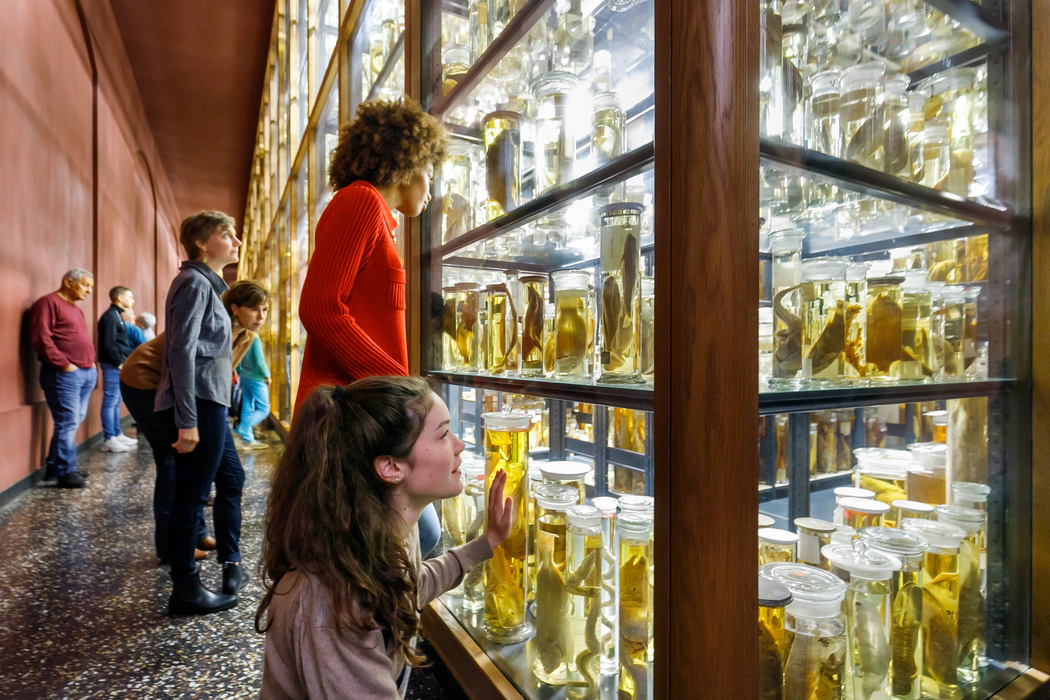
Humans may be sharing earth with up to twenty million species of macroscopic life, let alone microscopic life. Today, about 1.8 million species have been described and currently, we discover about 18,000 species per year, which means it would take us thousands of years to describe them all. This is why JOHANNES VOGEL endeavors to increase the current rate of discovery dramatically, as he explains in this video. Traditionally, taxonomy has relied of morphology as the method to describe nature. In order to introduce more speed, Vogel suggests methods such as DNA barcoding, entire genome sequencing, CT scans or X-rays. Bringing together modern technology, biodiversity informatics and even citizen science will increase the rate of discovery. This, in turn, will enable researchers to build a model of the living biosphere that allows us humans to work with the ecosystem, not against it, in order to sustain life on earth.

DOI:

https://doi.org/10.21036/LTPUB10585

Museum für Naturkunde - Leibniz Institute for Evolution and Biodiversity Science

The Museum für Naturkunde (MfN) - Leibniz Institute for Evolution and Biodiversity Science is an integrated research museum within the Leibniz Association. It is one of the most important research institutions worldwide in the areas of biological and geological evolution and biodiversity. We study life and planet Earth, maintaining a dialogue with people. Our mission, our vision, our strategy and our structure make our Museum an excellent research museum. We have research partners in Berlin, Germany and approximately 60 other countries. Over 800,000 visitors per year, as well as steadily increasing participation in educational and other events show that we have become an innovative communication centre that helps shape the scientific and social dialogue about the future of our earth – worldwide. Alongside knowledge transfer, research and our collections are the main pillars of the Museum’s work. The collections are a unique cultural asset and inextricably linked to our research. They comprise over 30 million items covering zoology palaeontology, geology and mineralogy and are of highest scientific and historical importance. The permanent exhibitions and the regular special exhibitions give the public an insight into current research at the Museum. They highlight original research objects, and visitors are encouraged and inspired to find their own route into research and experience ‘evolution in action’ rather than following a given pathway. (https://www.museumfuernaturkunde.berlin/en)

Museum für Naturkunde - Leibniz Institute for Evolution and Biodiversity Science

Original Publication

Mapping the Biosphere: Exploring Species to Understand the Origin, Organization and Sustainability of Biodiversity

Quentin D. Wheeler

,

Sandra Knapp

,

Dennis W. Stevenson

,

Jan Wassmer Stevenson

,

Stanley Blum

,

Brian M. Boom

,

Gary G. Borisy

,

James L. Buizer

,

Marcelo R. de Carvalho

,

A. Cibrian

,

Michael J. Donoghue

,

Vinson P. Doyle

,

Elihu M. Gerson

,

Catherine H. Graham

,

Patrick H. Graves

,

Sara Graves

,

Robert Guralnick

,

Andrew Hamilton

,

James Hanken

,

Wayne Law

,

Diana Lipscomb

,

Thomas Ε. Lovejoy

,

Holly Miller

,

James S. Miller

,

Shahid Naeem

,

Michael J. Novacek

,

L. M. Page

,

Norman I. Platnick

,

Holly Porter-Morgan

,

Peter H. Raven

,

M. Alma Solís

,

Antonio G. Valdecasas

,

Sander van der Leeuw

,

Alejandra Vasco

,

Niki Vermeulen

,

Johannes Vogel

,

Ramona Walls

,

E. O. Wilson

,

James B. Woolley

Published in 2012

Earth BioGenome Project: Sequencing Life for the Future of Life

Harris A. Lewin

,

Gene E. Robinson

,

W. John Kress

,

William J. Baker

,

Jonathan A. Coddington

,

Keith A. Crandall

,

Richard Durbin

,

Scott V. Edwards

,

Félix Forest

,

M. Thomas P. Gilbert

,

Melissa M. Goldstein

,

Igor V. Grigoriev

,

Kevin J. Hackett

,

David Haussler

,

Erich D. Jarvis

,

Warren E. Johnson

,

A.A.N. Patrinos

,

Stephen Richards

,

Carlos Rubio‐Terres

,

Marie‐Anne Van Sluys

,

Pamela S. Soltis

,

Xun Xu

,

Huanming Yang

,

Guojie Zhang

Published in 2018